
Clay County Criminal Case Files
A criminal court record is the court file, not just the accusation. In Clay County, Kansas, the District Court handles felony, misdemeanor, probation-violation, and criminal jury matters. The file can include the complaint or information, probable-cause material when public, appearance entries, bond orders, warrants or summonses, plea documents, motions, journal entries, sentencing documents, probation orders, financial entries, and docket events.
Clay County is in the 21st Judicial District with Riley County. District Court is the general trial court for state-law criminal cases, while Clay Center Municipal Court handles city ordinance and city traffic cases issued by Clay Center police. The Clay County Attorney, Brenda Jordan, prosecutes state-law and county-resolution violations, including felony crimes and juvenile crimes anywhere in the county, plus misdemeanor and traffic violations outside city limits.
The source image for the Clay County Attorney's role comes from the official Clay County Attorney page.
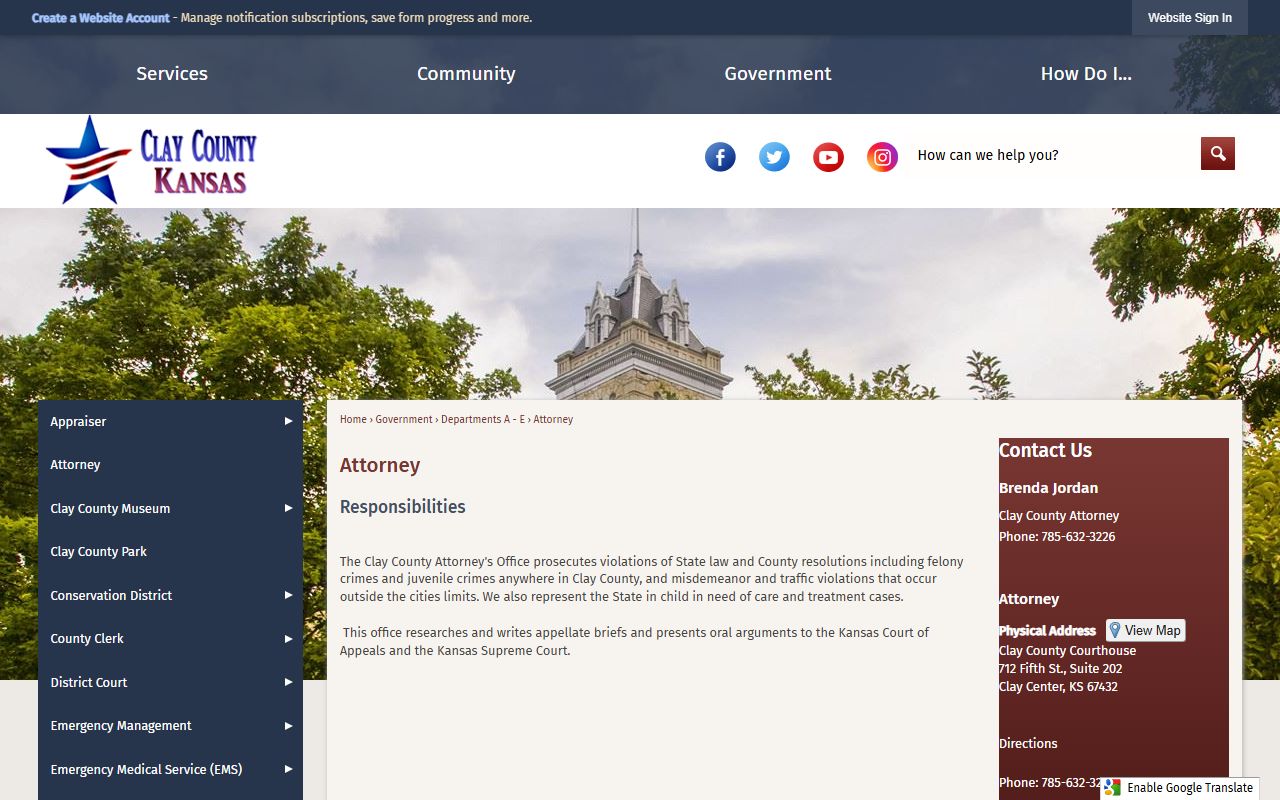
The County Attorney page is central to criminal court records because it identifies the office that prosecutes state-law charges before the court.
Search Clay County Criminal Records
Use Kansas CaseSearch for public Clay County District Court criminal case information. The statewide system replaced the former Kansas District Court Public Access Portal. It is useful for party-name, business-name, citation, case-number, and supporting identifier searches where the public portal supports those fields. For Clay County criminal court records not shown online, the local fallback is the Clerk of the District Court request form and mailed search fee.
- Search CaseSearch by case number first, if known.
- Use defendant name, date of birth range, SO number, booking number, FBI number, or citation number only when those fields fit the search.
- Confirm that the record is in Clay County District Court and not another 21st Judicial District county or Clay Center Municipal Court.
- Open the case summary and read the charges, docket events, hearing entries, plea, disposition, and sentence fields where public.
- Request copies or certification from the Clerk of the District Court when the online summary is not enough.
Clay County's open-record procedure requires a $12 search fee mailed to the Clerk of the District Court before a search is performed. The requester should give record titles, dates, court name, party name, date of birth if known, social security number if available, number of copies, and whether certified copies are needed.
Clay County Criminal Case Flow
Criminal court records change over time. An arrest or citation may start the process, but the court file develops as the prosecutor files charges, the defendant appears, motions are heard, and the case resolves through dismissal, diversion, plea, trial, disposition, or sentence. For a closer look at the accusations themselves, use the Clay County arrest records and court charges pathway.
Case flow: Charges Filed › Arraignment › Pretrial and Motions › Plea or Trial › Disposition › Sentencing
| Stage | What Happens |
|---|---|
| Charges Filed | The complaint, information, or other charging paper starts the case or places allegations before the court. |
| Arraignment | The court addresses the charges and plea, and may set bond, counsel, or future dates. |
| Pretrial and Motions | Attorneys file motions, request hearings, exchange discovery, and address suppression or dismissal issues. |
| Plea or Trial | The case resolves by plea, diversion, dismissal, bench trial, or jury trial. |
| Disposition | The court records the current or final outcome for each charge. |
| Sentencing | The judge enters jail or prison terms, probation, fines, costs, restitution, or other conditions when applicable. |
Clay County Criminal Record Fields
The court record should be read field by field. A charge line is not the same as a conviction, and a docket entry is not the same as the underlying motion or order. Public electronic access may omit documents, sealed details, juvenile material, personal identifiers, and other information withheld by Kansas Supreme Court Rule 22 or statute.
| Field | What It Shows |
|---|---|
| Case Number | The District Court identifier used for searching, payment, copying, and docket review. |
| Defendant | The person accused in the criminal case, with restricted identifiers redacted from public view. |
| Prosecutor | The State of Kansas or Clay County Attorney role in county-level state-law prosecutions. |
| Charges | Offense name, statute or citation, classification, filing date, and later amendments when public. |
| Bond or Warrant Events | Bond setting, warrant issued, warrant recalled, summons, failure-to-appear, or arrest-and-detain events. |
| Plea | The defendant's formal response, such as guilty, not guilty, no contest, or diversion-related entry. |
| Disposition | Dismissed, convicted, acquitted, diverted, amended, reduced, or otherwise resolved charge status. |
| Sentence | Jail, prison, probation, costs, restitution, payment plan, or supervision terms when public. |
The source image for the Clay County Attorney staff directory comes from the official County Attorney directory.
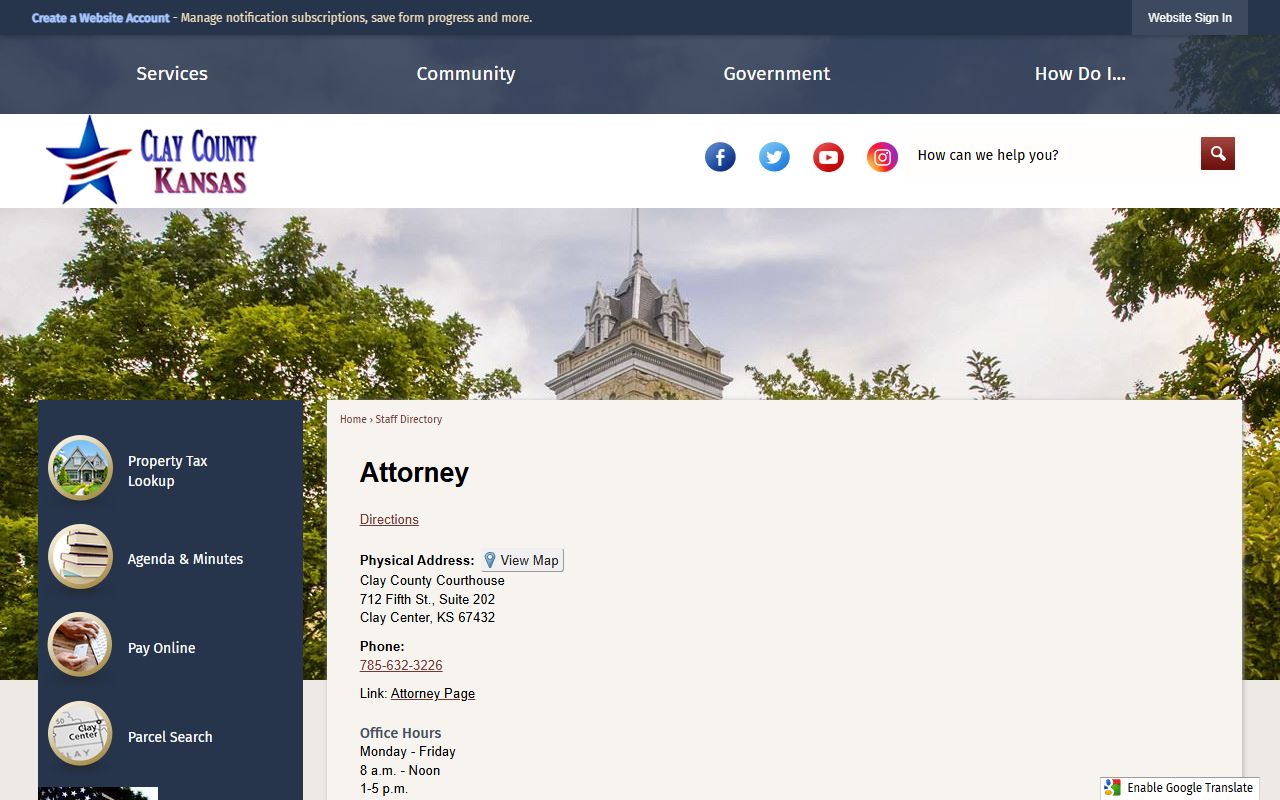
The directory supports the local office context for criminal court records without turning prosecutor contact details into case advice.
Clay County Charges vs Convictions
A Clay County criminal court record may show charges that were filed, changed, dismissed, reduced, or resolved by diversion. A charge is an accusation. A conviction is a court outcome after a guilty plea, no-contest plea accepted by the court, or verdict. The distinction matters for background review, expungement questions, and reading a case disposition correctly.
| Point | Charge | Conviction |
|---|---|---|
| Meaning | An allegation filed by the prosecutor or placed before the court. | A final court outcome based on plea or verdict. |
| Timing | Appears early and may change during the case. | Appears after the court accepts or enters the outcome. |
| Record Risk | May be dismissed, amended, reduced, or diverted. | May trigger sentence, probation, fines, costs, and criminal-history consequences. |
| Public View | Often public unless sealed, juvenile, expunged, or restricted. | Often public unless sealed, expunged, or otherwise restricted. |
Clay County Defense Counsel Records
Criminal court records may identify counsel of record. Eligible defendants obtain appointed counsel through the court and Kansas Board of Indigents' Defense Services system. The BIDS contact page lists the North Central Regional Public Defender Office at 715 N Washington St, Junction City, KS 66441, phone 785-238-2154. That office connection should be read as public-defense coverage context, not as a private hiring path.
The source image for appointed defense context comes from the Kansas Board of Indigents' Defense Services contact page.

Defense-counsel information helps explain attorney fields in criminal court records and why counsel entries may change during a case.
Clay County Warrants and Probation
Criminal court records can include warrant and bond events, but Clay County does not publish a complete official online active warrant list in the county sources checked. For warrants tied to District Court cases, CaseSearch may show public docket entries such as warrant issued, recalled, quashed, or bond set. For local confirmation, the official contacts are the Clerk of the District Court and the Clay County Sheriff's Office.
Local Rule 3.06 is relevant to probation and supervision violations. It authorizes supervision officers in the 21st Judicial District to use arrest-and-detain affidavits for probation, misdemeanor parole, community corrections, suspended sentence, or nonprison sanction violations, subject to approval. That kind of event may appear as a docket entry, warrant-related entry, or later hearing in a criminal case record.
Note: Do not treat a docket warrant entry as current without checking the court or sheriff for recall or satisfaction.
Clay County Criminal Record Access
Adult criminal court records are often public, but the public view is shaped by Kansas open-records law, Rule 22, and case-specific orders. K.S.A. 45-216 states Kansas public-record policy. K.S.A. 45-218 addresses prompt agency action on requests and the need to cite legal authority for denials. K.S.A. 45-230 restricts commercial use of names and addresses taken from public records, and the Clay County request form includes that certification.
For a practical search, start with public CaseSearch and then move to the Clerk of the District Court if the record needs a copy, certification, or document review. For a current custody question, the Sheriff's Office is the correct local law-enforcement channel. For state custody or supervision after sentencing, KDOC KASPER is a separate statewide corrections source and should not be confused with Clay County's criminal court case file.
Clay County Sealed Criminal Records
Some criminal court records are not public. Juvenile matters are restricted by Kansas juvenile statutes and electronic-access rules. Sealed records are closed by law or court order. Expungement is a petition-based process that limits public access to eligible convictions, arrests, and diversion agreements. Personal identifiers and confidential data may also be redacted from otherwise public copies.
| Point | Sealed | Expunged |
|---|---|---|
| Visibility | Closed from ordinary public inspection by law or court order. | Removed from ordinary public view after a granted petition. |
| How It Happens | By statute, court rule, or judge's order. | By petition under the applicable Kansas expungement statute. |
| Common Limits | Juvenile, confidential, investigative, adoption, or protected information. | Eligibility depends on offense, waiting period, completion of sentence or diversion, and exclusions. |
| Remaining Access | Limited court or criminal-justice access may remain. | Expungement may not erase records for every criminal-justice, licensing, or statutory purpose. |
The source image for Kansas expungement law comes from K.S.A. 21-6614.
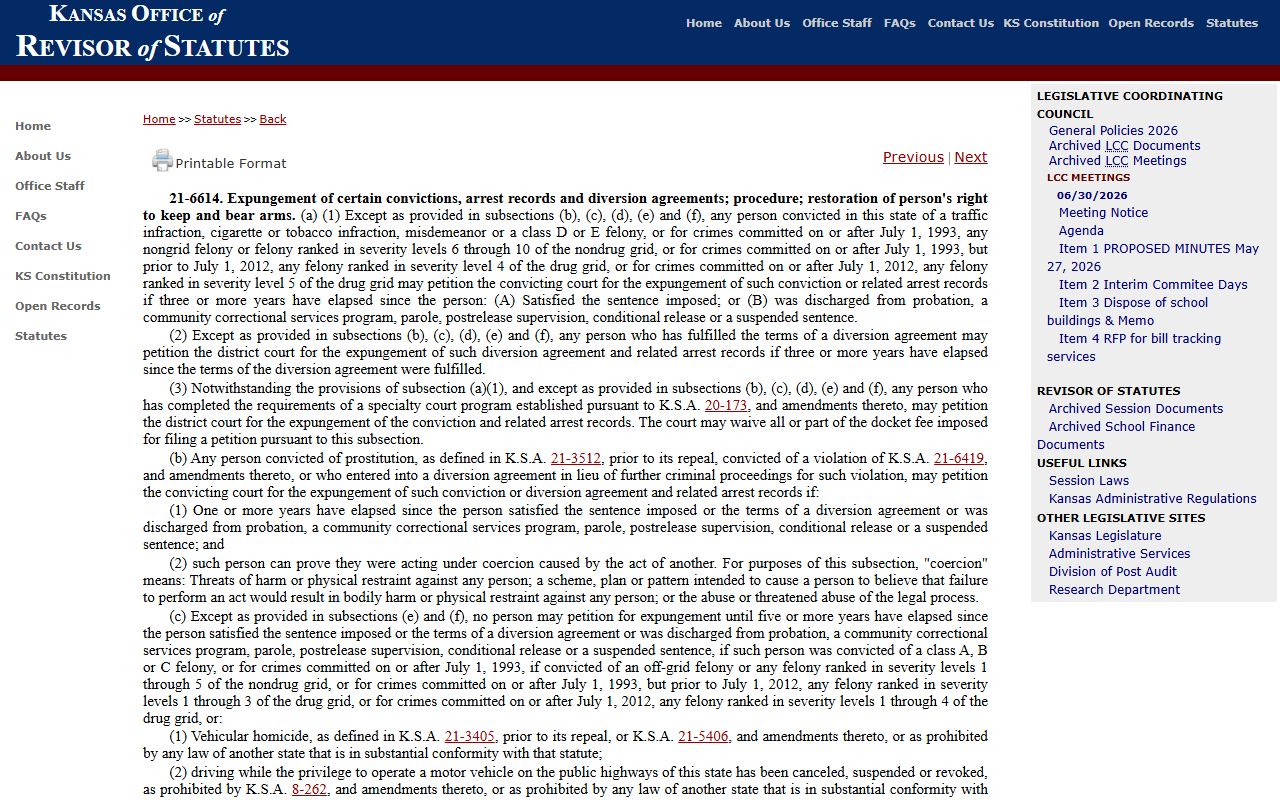
Expungement law is tied to criminal court records because petitions are filed through the court connected to the conviction, arrest, or diversion.
Clay County Juvenile Restrictions
Clay County District Court handles juvenile matters, but juvenile court and law-enforcement records have special disclosure rules. They may not appear through the same public electronic channels as adult criminal case files. Kansas juvenile statutes and Rule 22 can limit public access even where an event exists in the court system.
The source image for juvenile record statute context comes from the Kansas Legislature juvenile records article index.
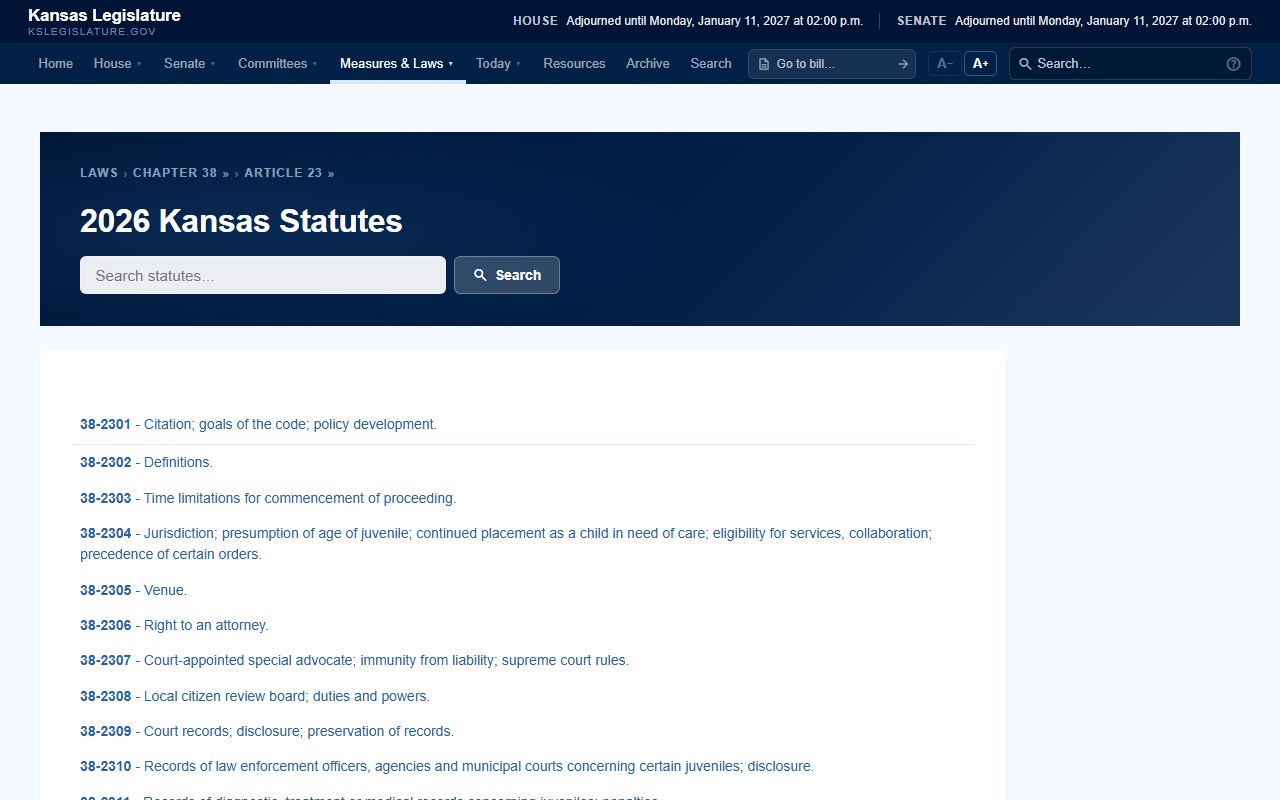
The juvenile statute source supports the caution that not all Clay County criminal or quasi-criminal records are open to public search.